1 R
1.1 Why learn R?
- Statistical Analysis
- R provides powerful tools for conducting complex statistical analyses, which is essential for many scientific and social research disciplines.
- Data Visualization
- R excels in creating high-quality, publishable graphics, enabling clear communication of data insights.
- Data Manipulation
- It includes extensive libraries for handling and transforming data, making it easier to prepare large datasets for analysis.
- Open Source
- R is free to use, with a vast community that contributes packages and support, reducing software costs and increasing accessibility.
- Career Opportunities
- Proficiency in R is highly valued in many careers such as data science, economics, actuarial science and biostatistics, enhancing job prospects. Specifically, the SoA (Society of Actuaries) requires R as the main tool in their Advanced Topics in Predictive Analytics (ATPA) assessment.
- Ease of Learning
- While Python is often considered beginner-friendly, R has a significant advantage for data-related tasks once you master the basics. Designed specifically for data manipulation and analysis, learning core data science skills—data manipulation, visualization, and machine learning—can be more straightforward in R.
1.2 What is R and Rstudio?
R is a language and environment for statistical computing and graphics. It is a free, open-source program for which there are abundant online resources to support its use. R can be downloaded from http://cran.r-project.org.
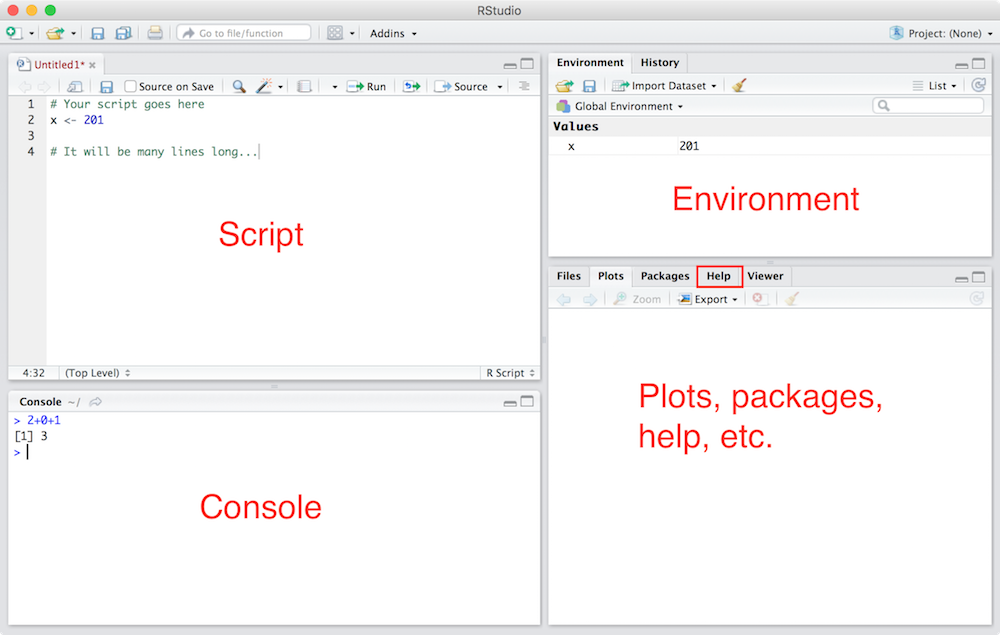
RStudio is an integrated development environment (IDE) for R. It includes a console, syntax-highlighting editor that supports direct code execution, as well as tools for plotting, history, debugging and workspace management. RStudio can be downloaded from https://www.rstudio.com/products/rstudio/download/.
1.3 What is CRAN?
R is downloaded from the Comprehensive R Archive Network (CRAN). You will see later that we can also download packages from CRAN.